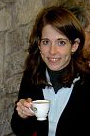
This is my all-time favorite cake. My mom often made it when we were growing up, and I make it at least a couple of times a year. It is delicious with Darjeeling tea. I love the cake's rich buttery vanilla flavor. It's also very easy to make.
Buttermilk Pound Cake
1/2 c butter (no substitute)
1/2 c crisco
3 c sugar
5 eggs
2 tsp vanilla
3 c flour (all purpose)
1/2 tsp salt
1 c buttermilk
1/2 tsp soda
1 Tbsp boiling water
Garnish: powdered sugar
Cream butter, shortening, and sugar. Add eggs one at a time, beating well. Add vanilla. Combine flour and salt. Add alternately with buttermilk, beginning and ending with flour. Dissolve soda in water and beat in. Pour into greased and floured tube pan and bake at 300 degrees for 1.5 hours, testing after 1.25 hours. Rest in pan for 10 minutes before turning out on a wire rack to cool. Before serving, I sift a little powdered sugar over the top to make it look pretty.
Out West I have to make this a bit differently if I want to get that gooey, not-quite-done layer at the bottom (my favorite part of the cake). The dry air and elevation, and my overly hot oven, required a little tweaking: I added 1.5 Tbsp of hot water instead of just 1 Tbsp, and I only baked it for an hour and 5 minutes. I lowered the oven temp slightly for the last 10 minutes of cooking to prevent excessive browning.
Tuesday, January 30, 2007

Monday, January 29, 2007
Liberty and Science
On Sunday afternoon I finished The Astonishing Life of Octavian Nothing, Traitor to the Nation, Vol. I: The Pox Party, by M.T. Anderson. It is beautiful and agonizing. I recommend it to everyone. The story is told primarily from the perspective of a young African-American boy who grows up with his mother in a house of scientists in pre-Revolutionary
To say more would revel too much, and I want you readers to have the untarnished benefit of plot turns and surprises. In fact, don’t read any of the reviews or summaries on Amazon’s page because most of them contain spoilers. You may also note on Amazon’s page that the book is marketed to young adult readers, which confounds me; it’s a book for adults or for adolescents with the capacity to appreciate books for adults.
There are so many levels to
The book ends with a cliffhanger, so Ickie and I are eagerly awaiting the sequel.
Thursday, January 25, 2007
I Only Sound Idiotic in Your Language
I just read “Jesus Shaves,” one of the few chapters I really enjoy in Me Talk Pretty One Day by David Sedaris. I thought of it after another rewarding visit to Engrish.com prompted my friend HR and I to reminisce about our days studying languages abroad. No one does a better job of describing the peril and confusion of trying to communicate in a second language than Sedaris in this book.
My reaction to Sedaris is completely polarized—I strongly dislike about 75% of Me Talk Pretty One Day and rather wish I hadn’t ever read those bits. However, there are two or three chapters I love dearly. Each time I read “Jesus Shaves,” I laugh until I can't breathe, so I recommend it wholeheartedly. (For those of you who appreciate a warning, it has a bit of bad language in it.)
What’s uniquely hilarious about Sedaris’s depiction of the challenges of language learning is the way he translates his awkward French back into hopelessly nonsensical English for the benefit of the reader. I'm sure many of the things I’ve said in German or Indonesian sounded exactly like his ungainly attempts. In one of my favorite scenes, he describes how his French progressed from toddler speak (using only nouns and gestures) to that of an inbred redneck: He walks into a butcher shop, points at some calves brains, and asks the butcher “Is thems the thoughts of cows?”
Learning a second language is a risky thing. It requires vulnerability and humility, which is why little children progress quicker than adults. When we are willing to speak out loud, we often make ourselves sound like idiots and offend other people. I once called my teaching supervisor in


Wednesday, January 24, 2007
Courage
This week I’m reading Josef Pieper’s A Brief Reader on the Virtues of the Human Heart because Ickie is leading a book group on it. Pieper’s language is lovely, even for a translation. I liked what he had to say about the virtue of fortitude:
I think a lot of folks who don't read stories in the fantasy or sci fi genre think I enjoy them because I like dragons and fairies and whatnot. Well, those things are indeed very appealing, but I primarily enjoy good fantasy stories if they are good books. In addition, I enjoy the freedom the author has to create very specific ethical situations without bowing to the reality to which we're accustomed. We can discuss these situations, characters, their choices, etc., and apply them to our lives even more effectively because we've had a chance to step out of ordinary circumstances. In this case, it's a beautiful depiction of selfless fortitude.
Tuesday, January 23, 2007
It's That Creepy Eyeless Fellow
The weekend before last, I went to see Pan's Labyrinth on its first night in the local theater. I had read a positive review of the movie here which contributed to my enthusiasm. Pan's is set in post-WWII Spain and is about a little girl who moves to the country with her mother to live with her new stepfather, a brutal officer who is hunting down separatists. The little girl's discovery of a magical labyrinth and the creature who lives there parallels a real-world narrative about her father's cruel treatment of his captives.
I was prepared for some serious terrors, but not for the gory details of the evil stepfather's work. I tend to distinguish the scary stories one sees in fairy tales from the more realistic and alarming details about the evils of which humans are capable. I'm not recommending Pan's to everyone--there are a lot of frightening scenes and I wish there had been less gore, but it's nonetheless a well-made movie. The graphic scenes served a purpose.
I enjoyed a lot about Pan's—the young actress is excellent (she's pensive and imperfect but courageous), the fantastical scenes are startling and tangible, and the two plot lines tie together in a strong ending. The highlight of the film is a terrifying scene featuring a ghastly eyeless monster sitting at a table overflowing with food that the girl is forbidden to eat. Oh dear, that scene is chilling! But in a good way.
The elements I liked about the movie were the same elements I enjoyed in The Book of Lost Things, which I read in December. They are both about children living during WWII in unhappily mixed families. Both children lose a parent, both love books (especially fairy tales), and both have "down the rabbit hole" adventures. Many of the fairy tale conventions are present in unique ways in these stories. Each child has a magical guide who may be a threat. Each child has to perform a series of tasks in order to prove his/her worth. Each child may be a royal heir to that kingdom. Each child has a baby brother in need of his/her protection. And both of them really creeped me out, which is the authentic nature of the original Grimm's tales, and nothing at all like the sterilized Disney versions.
I was prepared for some serious terrors, but not for the gory details of the evil stepfather's work. I tend to distinguish the scary stories one sees in fairy tales from the more realistic and alarming details about the evils of which humans are capable. I'm not recommending Pan's to everyone--there are a lot of frightening scenes and I wish there had been less gore, but it's nonetheless a well-made movie. The graphic scenes served a purpose.
I enjoyed a lot about Pan's—the young actress is excellent (she's pensive and imperfect but courageous), the fantastical scenes are startling and tangible, and the two plot lines tie together in a strong ending. The highlight of the film is a terrifying scene featuring a ghastly eyeless monster sitting at a table overflowing with food that the girl is forbidden to eat. Oh dear, that scene is chilling! But in a good way.
The elements I liked about the movie were the same elements I enjoyed in The Book of Lost Things, which I read in December. They are both about children living during WWII in unhappily mixed families. Both children lose a parent, both love books (especially fairy tales), and both have "down the rabbit hole" adventures. Many of the fairy tale conventions are present in unique ways in these stories. Each child has a magical guide who may be a threat. Each child has to perform a series of tasks in order to prove his/her worth. Each child may be a royal heir to that kingdom. Each child has a baby brother in need of his/her protection. And both of them really creeped me out, which is the authentic nature of the original Grimm's tales, and nothing at all like the sterilized Disney versions.
Saturday, January 20, 2007
We're Proud of Our Crazy
I don’t think I realized how much I would enjoy living in
Now, it’s been my experience that the population is equally insane regardless of which part of the country I’m in, it’s just handled a bit differently. On the
In
Today when we arrived at the farmer’s market, a large group of beaming young people was holding large signs announcing “FREE HUGS.” Ickie and I watched as a small boy recoiled in horror when an alarmingly gleeful stranger squatted down to embrace him. Shortly thereafter, we spotted a green Ford station wagon with longhorns attached to the front, piloted by a stern woman with a Mohawk and an arm full of vivid tattoos.
The biggest celebration of weirdness in  is year I wore my butterfly wings. I saw one girl dressed as a banana, another man as a Dr. Suess character on an acid trip (and we were just the spectators). My favorite person in the parade was a man who just showed up in his boxer shorts and bedroom slippers and strolled along the parade route.
Lots of people have told me that I'm weird or crazy, and I can't argue with them. I just have to keep up with the competition.
Thursday, January 18, 2007
Neither Great Nor Terrible...Thus Far
Currently I'm reading A Great and Terrible Beauty by Libba Bray. Whereas it's relatively interesting, I'm 100 pages in and it's not thrilling me. Perhaps that will change, but I don't have very high hopes for Bray's language. It's not that it's poorly written; it's grammatically correct but littered with the most perfunctory adjectives. There's something painfully bland about describing a garden as "a wonderful garden," when one could call it a lush garden, a well-tended garden, an overgrown garden, or a jasmine-scented garden. It feels like Bray wants to be elegant with her language but is trying too hard and not succeeding. The result is both melodramatic and trite. Now, her novel is supposed to be a takeoff on the cheap gothic novels of the Victorian setting she is using, so perhaps it's a clever nod to that affected style of writing. I'm not convinced.
Bray's descriptions of the magical visions or occurrences in the story feel too vague and metaphysical to me, and several times I've had to reread passages where the events depicted weren't concrete enough to hold my interest. Thus far the narrative has also reminded me strongly of the movies Mean Girls and Dead Poets Society, if you can imagine such a combination, but set in Victorian England with magical bits. Now, I'll be the first to admit that I am a sucker for: 1. A high school movie featuring an outsider and a bunch of mean kids; 2. A movie where The Man gets it stuck to him; and 3. A movie with literature enthusiasts (even if it involves the tiresome Whitman and Thoreau). Oh, and I'm forgetting the cute boys in their matching wool coats and sweater vests. Alas, Bray's novel doesn't have enough strapping young lads in sweater vests to make up for her banality.
This is all loosely related to my current dismay towards the way in which we underuse our vocabularies. The English language is rich, and it honestly is a joy to learn new words and use them. People, I beg you to stop using the words awesome and blessed, especially if you use them three times in one paragraph. Instead, try using the word hackneyed in a sentence (if you're not familiar with this word, look it up. I'm taunting you, and you need to be aware of that). Go back, reread what you've written, and substitute some fresh and rousing adjectives! Let's all go out and buy nice new thesauri and do credit to our educations.
Recommended: If you want a great satire of the gothic novel, read Jane Austen's Northanger Abbey. If you want one of the best gothic novels (and possibly best novels) ever written, then it's Charlotte Bronte's Jane Eyre for you.
Bray's descriptions of the magical visions or occurrences in the story feel too vague and metaphysical to me, and several times I've had to reread passages where the events depicted weren't concrete enough to hold my interest. Thus far the narrative has also reminded me strongly of the movies Mean Girls and Dead Poets Society, if you can imagine such a combination, but set in Victorian England with magical bits. Now, I'll be the first to admit that I am a sucker for: 1. A high school movie featuring an outsider and a bunch of mean kids; 2. A movie where The Man gets it stuck to him; and 3. A movie with literature enthusiasts (even if it involves the tiresome Whitman and Thoreau). Oh, and I'm forgetting the cute boys in their matching wool coats and sweater vests. Alas, Bray's novel doesn't have enough strapping young lads in sweater vests to make up for her banality.
This is all loosely related to my current dismay towards the way in which we underuse our vocabularies. The English language is rich, and it honestly is a joy to learn new words and use them. People, I beg you to stop using the words awesome and blessed, especially if you use them three times in one paragraph. Instead, try using the word hackneyed in a sentence (if you're not familiar with this word, look it up. I'm taunting you, and you need to be aware of that). Go back, reread what you've written, and substitute some fresh and rousing adjectives! Let's all go out and buy nice new thesauri and do credit to our educations.
Recommended: If you want a great satire of the gothic novel, read Jane Austen's Northanger Abbey. If you want one of the best gothic novels (and possibly best novels) ever written, then it's Charlotte Bronte's Jane Eyre for you.
Subscribe to:
Posts (Atom)