So, here's my nonfiction selection for the year: The Geography of Bliss by Eric Weiner. An interview with the author on The Daily Show, recent reports on "the world's happiest countries," and other books Ickie has read on happiness research peaked my interest. As I began The Geography of Bliss, I told Ickie I was initially disappointed by the lack of specific information and statistics--in other words, the book was less academic than I had expected. However, I came to understand that Weiner's book is simply a different (and not at all poor) concept; it's a travelogue with a running theme--the author's search for and musings about the nature of happiness.
Weiner visits multiple countries, some which scored high on the happiness scale (e.g., Switzerland, Iceland), some which scored mid-range (e.g., Great Britain, the US), and the most depressing place on earth: Moldova. Actually, the chapter on Moldova was the funniest. Each time Weiner interviewed anyone in Moldova (either natives or expats), they were hard pressed to think of anything positive about the place until each person finally conceded "the fruits and vegetables here are very fresh."
In each chapter, we get a clear feel for Weiner's impression (he didn't much enjoy Qatar, but he adored Iceland). Rather than simply ranking these countries on a happiness scale, Weiner contrasts each culture's understanding of happiness. The Qataris actually seemed offended when asked if they were happy, the Thais told Weiner not to think so much, the British felt that talking about happiness was "cloyingly American," and the Swiss dubbed envy as the greatest enemy to happiness. Weiner touches on all kinds of interesting concepts that spark deeper consideration but still manages to produce a book that is light, personal, and amusing.
Do I believe happiness can be a geographic location? It's certainly true that I'm more content in some climates and cultures than in others, and I don't expect everyone to agree with me. For example, those of you who know of my disgust for hot, muggy weather will understand my affinity for this quotation:
"Ibn Khaldoun, the great Arab intellectual of the fourteenth century...believed that the great curse of civilization is not war or famine but humidity: 'When the moisture, with its evil vapors ascends to the brain, the mind and body and the ability to think are dulled. The result is stupidity, carelessness, and a general intemperance."
Attacks on humidity aside, Weiner's book was a pleasant impetus for me to meditate on my own outlook on life and what influences it. His concluding advice is simple but affecting:
"Money matters, but less than we think and not in the way that we think. Family is important. So are friends. Envy is toxic. So is excessive thinking. Beaches are optional. Trust is not. Neither is gratitude."
Tuesday, August 5, 2008

Wednesday, July 23, 2008
Off the Reservation
I read The Absolutely True Diary of a Part-Time Indian by Sherman Alexie in one afternoon. It's written from the perspective of a 14-year-old Spokane Indian boy, and whereas Junior does sound like a typical teen (fart jokes and all), he offers many true, thoughtful observations about his world. The story has a lot of standards in good coming-of-age novels (e.g., Jim the Boy, Run with the Horsemen).
When Junior decides to transfer to the more-challenging "white" school in a local town, he is treated as a traitor on the reservation. Junior is awkward, poor, and lonely, but he finds unexpected kindness from others. He mourns the loss of his best friend and multiple deaths in the family as well as the more general self-destructive lifestyle of his tribe. Part of why the narrative works so well is that it's told by Junior in the first person, so he can confide all the touchy-feely emotions deemed unacceptable for adolescent males. The novel is filled with his funny, perceptive cartoons, such as a drawing of him and his former best friend in the third grade, jumping into a lake holding hands, with the caption: "Boys can hold hands until they turn nine."
Every crisis and triumph in Junior's life is an equal mixture of pain and joy. He reacts to so many miserable circumstances with crazed laughter, and it's hard to know whether you want to laugh or cry yourself. Alexie's novel is a keen combination of tragedy and hope, capturing perfectly the language of a teen-aged outsider.
Sunday, July 20, 2008
Spy Novel Versus Other Spy Novels
When I lived overseas and ran out of books to read, I borrowed a few of my boss's Tom Clancy novels. They were exciting, and when I stayed up late at night to read them, I'd hear the wild dogs rooting through my trash and imagine they were instead Russian commies.... But let's face it, Clancy, Ludlum, and the like treat their words as a technicality in the interest of fabricating a good plot. Espionage stories excite me, but they are often artlessly executed. Night Soldiers, the first novel I've read by Alan Furst, is an exception.
Most of Furst's novels are set during World War II, and his characters are often commoners caught up in the shifting European politics, attempting to survive the chaos. Night Soldiers is the tale of a young Bulgarian, Khristo, originally recruited by the Soviets but disillusioned by their methods. I had to grow accustomed to Furst's writing style, as some scenes are told from unusual points of view with ambiguous language. However, as the narrative proceeds, it grows progressively more exciting, culminating with the last few irresistible chapters.
Ickie said, "It's a spy novel, but by someone who can actually write well." Furst has obviously done in-depth research on the events and life in WWII-era Eastern Europe, a history I'd do well to understand better. Especially affecting for me were Khristo's reactions and observations upon meeting Americans, whom he sees as privileged and naive while also inspiring and admirable. Where Furst could have simply hustled along with his thrilling tale, he often pauses to consider deeper details about people and their actions. Some compare his work to Graham Greene, and while Greene's work is more contemplative (and more concerned with faith), it's a more apt comparison than to the pulpy spy novels. I look forward to checking out more books by Furst and trust they'll distract me from the inconvenience of being nine months pregnant.
Friday, July 18, 2008
"Do you need anything dampened or made soggy?"
 Joss Whedon, creator of Firefly (pretty much my all-time favorite show EVER), has created a hilarious web series, Dr. Horrible's Sing-A-Long Blog. It stars Neil Patrick Harris as Dr. Horrible, an aspiring super villian with a crush on a cute redhead at his local laundry mat. Nathan Fillion is a scream as Captain Hammer, the smarmy superhero who foils both Dr. Horrible's plots and love life. Act I begins a bit slowly, then takes off with the first of many musical numbers. It reminds me a bit of Pushing Daisies and Flight of the Chonchords. It features Whedon's typical witty dialog, and the songs are catchy as well.
Penny: ...I went on a date.
Dr. H: Get right out of town! How was that?
P: Unexpected. He's a really good-looking guy, and I thought he was kind of cheesey at first.
Dr. H: Trust your instincts.
P: But he turned out to be totally sweet. Sometimes people are layered like that. There turns out to be something totally different underneath than what's on the surface.
Dr. H: And sometimes there's a third, even deeper level, and that one is the same as the top surface one.
P: Huh?
Dr. H: Like with pie.
Watch the full three episodes in steaming video or download to itunes here.
Friday, July 11, 2008
Gender Bender
Today I dropped by the DMV to update my new street address in the system. While there, I pulled out my license, examined it more closely than usual, and realized they have my gender listed as "male." (I ca n only assume the DMV staff of last year were distracted by my muscular physique and luxuriant beard.) I turned to Ickie and asked him how he felt about having been legally married to a male for the past year. (I guess we're lucky our marriage hasn't been scandalously uncovered and dissolved now that we no longer live in California.) When I went up to the service window, I pointed out to the clerk the error on the license and said "I'll bet you don't get too many 8-months-pregnant males in here." He was so amused he ran to the neighboring cubicle to show his coworker.
In a few weeks I'll return to my official legal status of female. For now, I guess I should watch some sports on TV, grunt while I lift weights, and shout at some hot chicks from my vehicle while I still have the excuse to do so. I feel like I've missed some opportunities by not noticing this earlier.
 n only assume the DMV staff of last year were distracted by my muscular physique and luxuriant beard.) I turned to Ickie and asked him how he felt about having been legally married to a male for the past year. (I guess we're lucky our marriage hasn't been scandalously uncovered and dissolved now that we no longer live in California.) When I went up to the service window, I pointed out to the clerk the error on the license and said "I'll bet you don't get too many 8-months-pregnant males in here." He was so amused he ran to the neighboring cubicle to show his coworker.
In a few weeks I'll return to my official legal status of female. For now, I guess I should watch some sports on TV, grunt while I lift weights, and shout at some hot chicks from my vehicle while I still have the excuse to do so. I feel like I've missed some opportunities by not noticing this earlier.
Thursday, July 10, 2008
The Lovely Complexity of an Ordinary Life
Back in March I wrote a glowing post about Jim the Boy, a simply and beautifully written novel by Tony Earley about a little boy growing up in a small town during the Great Depression. I'm happy to report that the second novel Earley wrote about Jim Glass is just as good as the first. Whereas the first novel follows Jim for a year when he was about 10 years old, The Blue Star records Jim's senior year in high school. Jim's widowed mother and funny, fatherly uncles are still present as is Earley's familiar, effortless prose. The plot is somewhat more mature due to Jim's age, and World War II propels events in the town. Jim's friendship with his insightful ex-girlfriend is as moving to me as his at-odds romance with a struggling half-Cherokee girl.
There's something about Earley's writing I find impossible to justly describe. His stories are sentimental without descending into melodrama or affectation. Your heart bleeds for each character; they live humble, ordinary lives, but Earley can infuse an ordinary life and the simplest of phrases with great poignance. After finishing the book last night, Ickie asked me about it (he read this one prior to me as well as the first), and I couldn't talk about a single scene without getting all choked up. If you're a fan of Southern literature or coming-of-age stories, you'll especially appreciate Jim the Boy and The Blue Star.
There's something about Earley's writing I find impossible to justly describe. His stories are sentimental without descending into melodrama or affectation. Your heart bleeds for each character; they live humble, ordinary lives, but Earley can infuse an ordinary life and the simplest of phrases with great poignance. After finishing the book last night, Ickie asked me about it (he read this one prior to me as well as the first), and I couldn't talk about a single scene without getting all choked up. If you're a fan of Southern literature or coming-of-age stories, you'll especially appreciate Jim the Boy and The Blue Star.
Sunday, July 6, 2008
Cultivating A Green Thumb
In the past I've been hopeless at keeping plants alive, but since moving into our new house, I've made an extra effort, and it has paid off. The previous owner was a master gardener, so all we had to do was watch our back hillside garden bloom in the spring and continue to bloom all summer (at present it's covered with yellow and orange lilies). I managed to plant impatiens and hostas in the front garden, and they have flourished.
Inspired by that small success, yesterday Ickie and I drove over to the most extensive and impressive nursery I've ever visited and bought a montmorency cherry tree for our yard as well as some potted herbs. The tree will commemorate our first year in the house as well as the summer The Kid is born. We'll be able to admire a tree full of these blooms next spring:
...and more importantly, a tree full of these tart cherries for pie and jam:
(Some of you know tart cherry is my favorite type of pie/jam, and I obsess about the cherry season each year.) Granted, it'll probably be several years before the tree can yield enough fruit for half a pie, and I suspect we'll need to make a concentrated effort to keep the rouge birds and squirrels from eating them, but I'm excited all the same. At the nursery I fought the inclination to buy every fruit tree in sight and turn our tiny back yard into an orchard full of apples, plums, pears, and cherries because I figure The Kid will want a bit of space for throwing a ball around without hitting one of mommy's trees.
Inspired by that small success, yesterday Ickie and I drove over to the most extensive and impressive nursery I've ever visited and bought a montmorency cherry tree for our yard as well as some potted herbs. The tree will commemorate our first year in the house as well as the summer The Kid is born. We'll be able to admire a tree full of these blooms next spring:
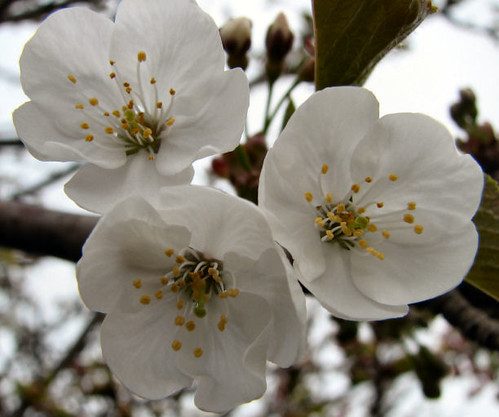
...and more importantly, a tree full of these tart cherries for pie and jam:
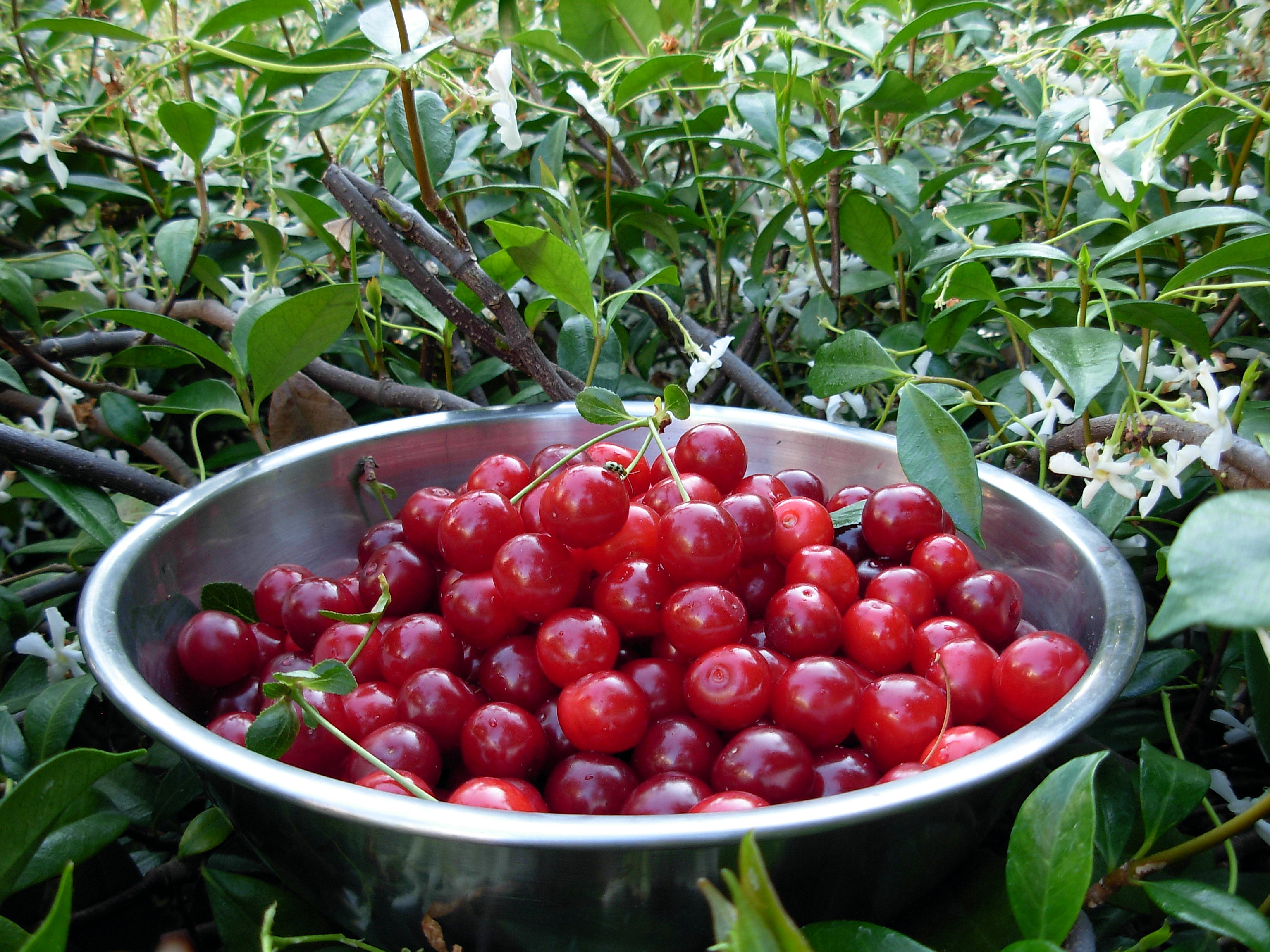
(Some of you know tart cherry is my favorite type of pie/jam, and I obsess about the cherry season each year.) Granted, it'll probably be several years before the tree can yield enough fruit for half a pie, and I suspect we'll need to make a concentrated effort to keep the rouge birds and squirrels from eating them, but I'm excited all the same. At the nursery I fought the inclination to buy every fruit tree in sight and turn our tiny back yard into an orchard full of apples, plums, pears, and cherries because I figure The Kid will want a bit of space for throwing a ball around without hitting one of mommy's trees.
Subscribe to:
Posts (Atom)