I have often been accused by Jackamo of not being forthcoming with my mushy feelings. I let people know how I feel, and I'm sincere about it, but I rarely gush. And since I've grown up, I've found that I despise most romantic comedies. On the rare occasions when Ickie is out of town, my plan is to move a few movies up on our Netflix queue that only I'd enjoy. But each time I have the same realization: we like and dislike the same things. If I like a romantic movie, he'd almost certainly enjoy it as much.
Now, I know there are just as many BAD romcoms as comedy, drama, horror, or action movies. I think what bothers me is that people who don't know me assume that I'll enjoy this trash just because it's aimed at women. I also believe the superficial relationships and manifold fallacies found in romcoms are quite damaging to lonely, impressionable females (we've all been there at some point). For several fine examples, I direct you to a list of "10 beloved romantic movies that are cloying, annoying, or unintentionally dysfunctional." There are so many I thought of adding to this list that there's no room here to discuss them. But just in time for Valentine's Day, I thought I'd mention some films I find to be genuinely romantic as well as having other fine qualities.
Northanger Abbey (2007): The leads are charming and funny, the satire is spot on, and the love story is never too heavy.
BBC Pride & Prejudice (1995): Once again I'll point out Austen writes comedy, not romance, but Lizzie and Darcy are able to achieve both with their clever banter and the depth of admiration they build for each other. Woe to all remakes.
A Room with a View (1985): This movie as well as the book has my favorite kisses in it: they are sudden and lusty--on an Italian hillside, in an English garden--and they make me feel all swoony.
Amelie (2001): Sure, there's a love story between two quirky characters, but the real love story is of a free-spirited life in candy-colored Paris.
Mostly Martha (2001): This German movie has all the conventions of a romantic comedy, but it still manages to do them well, and it's improved by an abundance of good food and culture shock.
Eternal Sunshine of the Spotless Mind (2004): This is the most heartbreaking and true of the list. They know the relationship is hopeless, but they are so drawn to each other they're willing to take the risk anyway. Beautiful.
Sliding Doors (1998): This is probably the weakest entry on the list, but I still like the way it contrasts two separate story lines and toys with the themes of chance and destiny.
Roman Holiday (1953): This is my favorite romantic classic, not to mention the ideal date: joyriding around Rome on a Vespa. And like the most moving stories, the characters make selfless, honorable decisions in the end.
Shakespeare in Love (1998): It's a clever, hilarious story about the world's most famous playwright, and it's wonderfully passionate.
An Ideal Husband (1999): Who better to portray the nonsensical madness that is love than a gay playwright and a gay lead actor?
Before Sunrise (1995) & Before Sunset (2004): Both of these movies feature actual dialog between two people falling in love with each other, which is typically removed from romcoms (in favor of insipid montages). Both movies are a snapshot of the couple's life, set in a day, casually wandering around European cities. I applaud the opened ended conclusions of both movies. The second movie's ending rather goes against my moral judgment, yet I still can't resist it.
Strictly Ballroom (1992): Baz Luhrman combines pop music, tacky subculture, and comic opera like no one else. It's ridiculous and laughable, and the melodramatic final scene makes me absolutely giddy.
Much Ado About Nothing (1993): This is my favorite of Kenneth Branaugh's efforts to take Shakespeare to the modern masses. The scenes lush and gorgeous, and the rapport between Branaugh and Emma Thompson is positively delicious. (Although, Ickie and I are always sad when we watch it, regretting that those two broke up in real life.)
Wednesday, February 13, 2008

Wednesday, February 6, 2008
Mixed Bag
It's always hard to know how consistent a collection of short stories will be. In any collection there are inevitably some stories I strongly prefer to others. Two collections I've recently enjoyed have been Suzanna Clarke's British fairy tales, The Ladies of Grace Adieu, and Jhumpa Lahiri's Indian-American stories, Interpreter of Maladies. Clarke has given much credit to Neil Gaiman for her ideas, and thus far I had only read Gaiman's Stardust (I actually think the movie is a lot more fun than the book, which I found a bit flat and anticlimactic). With encouragement from Hayumbone, I gave Gaiman another try, checking out his only book at my local library branch, the short story collection Smoke and Mirrors.
I actually haven't finished it yet and am not sure I will. This is due to its wide range of story genres, most of which I can appreciate, but just a handful of which I really enjoy. In fact, my reaction to stories has ranged from loving one so much I read it twice in one day, to near indifference for several others. The same thing happened to me when I tried to read a second collection by Kelly Link, Magic for Beginners (LOVED the first story, couldn't drum up interest in the others).
Anyhoo, there are three stories in Smoke and Mirrors that I highly recommend. The first, oddly enough, is found in the introduction. "The Wedding Story" ends with a punch in the gut, but in a good way. The second is "Chivalry," a hilarious Arthurian update in which an old lady finds the holy grail at a secondhand shop in present day England, and when a knight (complete with armor and noble steed) appears to claim it, she puts him to work doing odd jobs around her house. The third story (and the one I read twice in one day) is "The Price." It gives me the creeps while simultaneously making me feel pierced and elated. It features a mighty peculiar cat, and you can read it online, but I recommend printing it out and reading it in bed late at night. I think I need to go read it a third time right away, actually. If all of Gaiman's writing were like this story, I'd consume it ravenously.
Thursday, January 24, 2008
Marvelous Oddities
I just completed two more selections from The New York Review Children's Collection: The Magic Pudding by Norman Lindsay and The Wind on the Moon by Eric Linklater. Conceptually, they are two of the oddest books I have read, and that is a good thing.
Pudding, published in 1918 in Australia, is the story of a koala (Bunyip Blugum), a sailor (Barnacle Bill), and a penguin (Sam Sawnoff). They own an inexplicably weird magic pudding, who goes by the name Albert, insists on people constantly eating him, changes flavors at request, replenishes himself mysteriously after each meal, and is perpetually grouchy. Essentially this is a story about eating and fighting, which Lindsay considered to be the two topics of prime interest for children. The Pudding Owners are constantly battling the wily Pudding Thieves (a scheming possum and wombat). It's a nonsensical setup with no clear plot, simply moving from one outrageous episode to the next, similar to Lewis Carroll's Alice stories. The highlights of the book are the manifold songs and poems (very silly indeed) and the drawings. Lindsay was actually a professional artist, a satirical cartoonist with a healthy disrespect for authority, and this translates wonderfully into drawings of a gruff sailor and pudding shaking their fists angrily at their offenders or the final chaotic trial scene (watch a great video featuring many of the sketches here).
One of the most unique and amusing details about Pudding is the character's language. The characters have a wide vocabulary, and they mix high-falutin' language with hilarious slang. It's slightly reminiscent of Bertie Wooster. For example:
" 'This is what I call satisfactory,' said Bill, as they sat at breakfast next morning. 'It's a great relief to the mind to know that them puddin'-thieves is sufferin' the agonies of remorse, and that our Puddin' is safe from bein' stolen every ten minutes.'
'You're a bun-headed old optimist,' said the Puddin' rudely. 'Puddin'-thieves never suffer from remorse. They only suffer from blighted hopes and suppressed activity.' "
Moon's protagonists, by contrast, are two young sisters, Dinah and Dorinda, cursed with a year of naughty behavior when their father observes "there is a wind on the moon" (don't ask me to explain it). The sisters' father goes to war, and they're left in the care of their distracted mother and tiresome tutor in a small town. The girls go from one adventure to the next, eating until they swell to huge balloons, then crying until they waste away, visiting a witch in the forest, turning themselves into kangaroos and being put in the local zoo, helping the zoo animals solve a mystery, freeing a puma and falcon (who become their devoted friends), helping their dance instructor escape from prison, etc. Like many children, Dinah and Dorinda are confounded by how often their well-intentioned acts are scolded by adults. It is a bit of a growing-up book as the girls become more and more clever and unselfish. It also contains one detail (in common with Pudding) I love about British children's books in the early to mid 20th century: long lists of food. (The book was published in 1944, so rations probably provided some inspiration.) Ultimately Moon is a book about freedom, and though it is unarguably whimsical, there's an underlying quest for liberty, even if that quest is at times judged to be rather naughty.
Pudding, published in 1918 in Australia, is the story of a koala (Bunyip Blugum), a sailor (Barnacle Bill), and a penguin (Sam Sawnoff). They own an inexplicably weird magic pudding, who goes by the name Albert, insists on people constantly eating him, changes flavors at request, replenishes himself mysteriously after each meal, and is perpetually grouchy.
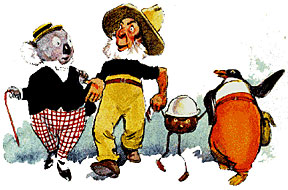 Essentially this is a story about eating and fighting, which Lindsay considered to be the two topics of prime interest for children. The Pudding Owners are constantly battling the wily Pudding Thieves (a scheming possum and wombat). It's a nonsensical setup with no clear plot, simply moving from one outrageous episode to the next, similar to Lewis Carroll's Alice stories. The highlights of the book are the manifold songs and poems (very silly indeed) and the drawings. Lindsay was actually a professional artist, a satirical cartoonist with a healthy disrespect for authority, and this translates wonderfully into drawings of a gruff sailor and pudding shaking their fists angrily at their offenders or the final chaotic trial scene (watch a great video featuring many of the sketches here).
One of the most unique and amusing details about Pudding is the character's language. The characters have a wide vocabulary, and they mix high-falutin' language with hilarious slang. It's slightly reminiscent of Bertie Wooster. For example:
" 'This is what I call satisfactory,' said Bill, as they sat at breakfast next morning. 'It's a great relief to the mind to know that them puddin'-thieves is sufferin' the agonies of remorse, and that our Puddin' is safe from bein' stolen every ten minutes.'
'You're a bun-headed old optimist,' said the Puddin' rudely. 'Puddin'-thieves never suffer from remorse. They only suffer from blighted hopes and suppressed activity.' "
Moon's protagonists, by contrast, are two young sisters, Dinah and Dorinda, cursed with a year of naughty behavior when their father observes "there is a wind on the moon" (don't ask me to explain it). The sisters' father goes to war, and they're left in the care of their distracted mother and tiresome tutor in a small town. The girls go from one adventure to the next, eating until they swell to huge balloons, then crying until they waste away, visiting a witch in the forest, turning themselves into kangaroos and being put in the local zoo, helping the zoo animals solve a mystery, freeing a puma and falcon (who become their devoted friends), helping their dance instructor escape from prison, etc. Like many children, Dinah and Dorinda are confounded by how often their well-intentioned acts are scolded by adults. It is a bit of a growing-up book as the girls become more and more clever and unselfish. It also contains one detail (in common with Pudding) I love about British children's books in the early to mid 20th century: long lists of food. (The book was published in 1944, so rations probably provided some inspiration.) Ultimately Moon is a book about freedom, and though it is unarguably whimsical, there's an underlying quest for liberty, even if that quest is at times judged to be rather naughty.
Monday, January 21, 2008
Is It Really Possible to Read Too Many Novels?
A friend came over last night for tea, and we all watched Masterpiece Theatre's new adaptation of Northanger Abbey. Unlike last Sunday night's new offering of Persuasion (which Ickie and I thought rather poor), Northanger Abbey was lively and hilarious. I had high hopes for the adaptation of that novel, as it's a relatively simple plot to fit into 1.5 hours, and the heroine's imagination, as a result of reading too many gothic novels, leads to a spot of amusing trouble. Felicity Jones, who played Catherine Moreland, was extremely likable with her comic facial expressions. We also quite liked J.J. Field, who was cast as Mr. Tilney, and reminded us a bit of Lee Pace from Pushing Daisies.
I thought this was an especially successful Austen adaptation, as it focused appropriately on the satire and treated the romance very lightly. We were particularly entertained by the depiction of Bath as a huge singles bar, with young men ogling young ladies in every shop and on every street corner.
If you missed the 2007 adaptation of Northanger Abbey, it's now available on Netflix. Next Sunday night PBS is showing a new version of Mansfield Park.
This past week we also watched Masterpiece Theatre's 2006 version of Jane Eyre, and I have to say, although imperfect, it is by far the best adaptation of that novel I've seen. This is partly because all the other actors cast as Jane and Rochester have been DREADFUL. Finally they found a plain and reserved yet stubborn and sharp-witted woman to play Jane, and Toby Stephens was brooding yet endearing as Rochester. No adaptation of this book will ever improve upon the novel, and although they made up some dialog, left out some of the important religious themes, and rushed through Jane's childhood, overall the miniseries was true to the feel of the novel and beautiful to watch, and Jane and Rochester had a rather thrilling chemistry.
Thursday, January 10, 2008
"Full of Rage and Slathered in Confusion"
A devout fan of James Lileks's Gallery of Regrettable Food, I enjoy it when a gifted wordsmith mocks bad food. As a result, I laughed the hardest I've laughed all week when I read Patton Oswalt's review of the KFC Famous Bowl, found on The Onion's A.V. Club site. Ickie and I have groaned not just a few times at the commercials for this affront to comestibles.
I'm not sure exactly what it means to say "Everything inside the store—including the employees and customers—looked like it had been rubbed with sad ham," but somehow it creates a vivid, horrifying mental picture. The last time I ate at a KFC was in Indonesia, after which I checked into the hospital with food poisoning.
I'm not sure exactly what it means to say "Everything inside the store—including the employees and customers—looked like it had been rubbed with sad ham," but somehow it creates a vivid, horrifying mental picture. The last time I ate at a KFC was in Indonesia, after which I checked into the hospital with food poisoning.
Monday, January 7, 2008
Jane Austen News
Check out Ickie's post on the Masterpiece Theatre airings of all Austen's novels (alas, Lady Susan is not included). They're showing an older version of Emma starring Kate Beckinsale of which I'm not a huge fan, but I'm looking forward to hopefully accurate adaptations of Mansfield Park and Northanger Abbey (which could be pretty funny). I do think it's hard to improve upon the Emma Thompson/Ang Lee version of Sense and Sensibility (even if Hugh Grant looked wretchedly uncomfortable in his cravat). I also quite liked the 1995 version of Persuasion starring Amanda Root and Ciaran Hinds, so I'm not sure I understand why they're redoing it, but I'll give it a go. Although I think Olivia Williams is too pretty to play Jane, I'm fond of her mannerisms and look forward to giving the autobiography a chance.
It goes without saying that this is welcome entertainment during the writer's strike.
It goes without saying that this is welcome entertainment during the writer's strike.
Friday, January 4, 2008
There Are Just Barely Enough Here for Me
Two years ago, I was walking through the farmer's market in Santa Barbara and sampled what they referred to as an "asian pear." It was bright green and lemon-shaped and had an uber-crisp (never grainy or mushy), white inside that was watery and subtly sweet with a hint of nutmeg. I fell rapturously in love and bought as many bags as I could carry. Right before we moved East, I noticed Trader Joe's was carrying them and consumed at least a dozen per week.
I left the West Coast with a tragic sense of loss regarding fresh olive oil and these glorious pears, as I had never seen them in other parts of the country. Ickie thoughtfully purchased some "asian pears" for me after we moved to Maine, but they were a more ubiquitous, mealy variety (large, yellow, and apple-shaped), not to be compared with my personal ambrosia.
 Then one week ago, I walked into a local Hannaford's and discovered a small pile of these very pears, termed more accurately "fragrant pears." Amid fits of joy, I bought ten and ate most of them in three days, then returned with Ickie and bought a dozen, at which time I informed him that if he wanted any of those pears, he would have to buy more for himself because I barely had enough. Last night he suggested I add them to a salad, and I shuddered in horror. (These are EATING pears, not salad pears. They are elitists and don't go well with anything but themselves.)
Apparently these have been prized as a delicacy in China for years and only recently were approved to be imported to the U.S. The NYT reports the following:
"Chinese officials asked to export Fragrant pears to the United States in 1993, but American pear growers raised concerns that the imported fruit might introduce exotic plant pests and diseases."
This reveals an insidious conspiracy on the part of the pear-growers of America to rob us all of China's superior fruit. They want me to sit idly by and be content with their mealy, squashy produce, and I will not have it! Ralph Waldo Emerson said, "There are only ten minutes in the life of a pear when it is perfect to eat." These are the anguished words of a man who has been forced to eat Barlett pears all his life, who was cut off from the bounty of China, and who has not yet dreamed of the glories of free trade. (In contrast to most North American and European varieties, fragrant pears stay crisp and perfect for a week or two in the fridge.)
To those of you who object to eating anything but local and organic produce, EXCELLENT. It just leaves more fragrant pears for me.
Subscribe to:
Posts (Atom)