Monday, January 31, 2011

Dessert Options

After making a batch of horrendously unhealthy Special K bars (not part of the Special K diet plan!) and having hypoglycemic attacks in the middle of the night, I decided I needed an alternative dessert on the healthier side. I found a can of pumpkin in my pantry, cobbled together a few recipes (including a diabetic one), and then just added some of my own stuff to create a pumpkin pie that turned out to be light, creamy, moist, and flavorful. Little Ben is wild for it. Every night he asks for pumpkin pie and gets a slice. Honestly, I consider it a vegetable, and it's the only way I can get any citrus into him. Now if I could just find a way to make myself forget there are choco-PB bars in the house as well....

My Pumpkin Pie

Make a basic 9-inch pie crust and put it in the pie plate. I actually made one out of wheat flour, which is fine, but I'll go back to white flour next time because I prefer its texture.

15 oz can of pumpkin
1/3 c granulated sugar
2 Tbsp real maple syrup
1.5 tsp pumpkin pie spice (or a mixture of cinnamon, nutmeg, cloves, and ginger)
2 beaten eggs (I reserved about a tsp of this for brushing on the crust's edge.)
1 tsp vanilla
1/2 c skim milk
zest of one tangerine or orange
1/4 c tangerine or orange juice

Mix it all together well and pour it into the pie crust. Bake at 400 degrees for 10 minutes and then reduce heat to 350 until center is set (45 minutes to an hour).

Heyer Mysteries

I have read so many Heyer mysteries since my last post that I've lost count, but I'm going to get it together and make a list right here. I have developed a pretty serious addiction (akin to my weaknesses for Afrin or these damn things), and I'd start reading another one right away if I had one at home. I don't, and I'm enjoying the first few chapters of Terry Pratchett's Bromeliad Trilogy, but I'm experiencing Heyer mystery withdrawal (which no amount of tea seems to assuage).

I seem to have read these in pretty much the right order, going through the three Hannasyde stories and continuing on to the Hemingway stories. Hemingway is Hannasyde's subordinate in the early ones and later becomes a superbly enjoyable Chief Investigator with charm, pointed wit, and a stellar memory. (I told Ickie I enjoy it as much as in Foyle's War when the investigator bluntly informs a suspect that he knows he's lying to him.) Also, some of the romantic plots will be given away if you don't read in the order below.

Why Shoot a Butler?
Footsteps in the Dark (Funny, but ended up being my least favorite of all of these, and not really a typical mystery, in my opinion.)
Death in the Stocks (The sibling suspects in this book have some of the most hilarious dialogue I've ever read. I laughed out loud multiple times.)
Behold, Here's Poison (My favorite character in this one, Randall, is described perfectly as an "amiable snake." I need more Randall. Next to Hemingway, he's probably my favorite character in Heyer's novels thus far, and that is saying A LOT.)
They Found Him Dead (The pacing here is a bit iffy, but Hemingway starts to really show his stuff, and we're introduced to Terrible Timothy, who is just adorable.)
Duplicate Death (Terrible Timothy and his half brother return, and Hemingway is now the Chief Inspector. The characters were a bit less flamboyant, but it is still a diverting read. I found it very funny when Hemingway's subordinate annoys him by slipping into Gaelic.)
No Wind of Blame (The explanation of the murder wasn't altogether convincing, but the melodramatic scenes of Mrs. Carter and her daughter are an absolute scream.)
Detection Unlimited (Just finished this last night. I often guess who the murderer is in Heyer's mysteries, but I was clueless here until the end, and I appreciate that. There are many hilarious moments, and Hemingway is in rare form. I love that several older ladies agree that it is so nice that a murder occurred so the young people have something to entertain them while they are staying in the country. That just goes to show you how lighthearted a murder mystery can be.)

Tuesday, December 7, 2010

Mysteries of One Kind, and Another

I've been reading lots of Georgette Heyer books these days. Never heard of her? She's a mid-20th-century British author, and although she's mostly famous for her Regency romances, she wrote excellent mystery novels as well. I read Black Sheep, a romance, first, which was a good bit of fun: Think Jane Austen that has a modernized mindset and is more lighthearted comedy than social satire. Then I read Why Shoot A Butler?, which I absolutely loved. It's a good enough plot (I never have a clue who the guilty party is, so I'm not an expert), but the sarcastic protagonist, witty dialog, and memorable characters are what really makes it worthwhile. It reminds me of Wodehouse, especially the clever butler and the Bingo Little facsimile. I've never been big on mysteries. I've read a couple by Agatha Christie and Dorothy Sayers, and I can't understand why Heyer isn't more famous. I've requested several more from our library and am currently enjoying Footsteps in the Dark, a comedy of errors/mystery set in an old country house in England, of course!
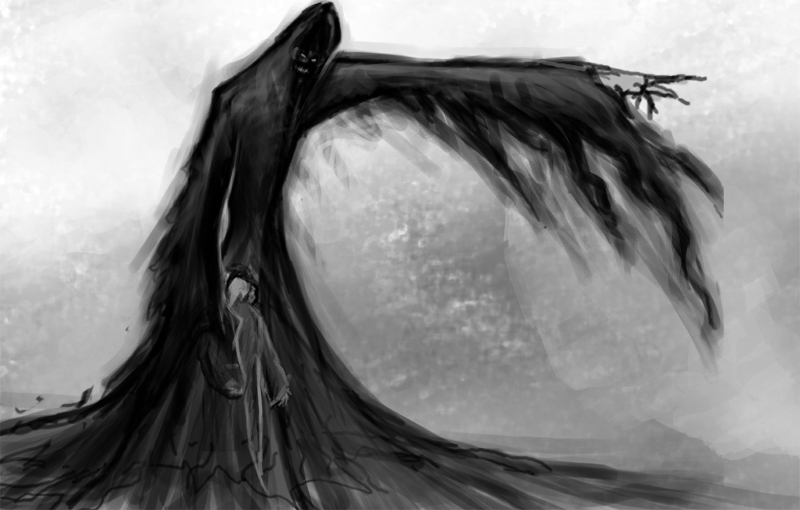
Since it's Advent, I also read Connie Willis's Miracle and Other Christmas Stories. While it's not her strongest work, I really enjoyed all of the short stories, including stories about a choir member sheltering a homeless man and his pregnant wife in the church nursery, an unpleasant man trapped in a busy toy store at Christmastime, and an interesting new role for the Christmas Carol ghosts. The very short story Pony (the name says it all) cracked me up. However, I think Willis's introduction was most resonant for me. I told Chris afterwards that it was better than any Midnight Mass homilies I've heard. She's just talking about why she likes Miracle on 34th Street and A Christmas Carol, but her comments get to the heart of the matter.

"Christmas is supposed to be based on selflessness and innocence, but until the very end of Miracle on 34th Street, virtually no one except Kris Kringle exhibits these qualities....But in spite of this (actually, in a delicious irony, because of it) and with only very faint glimmerings of humanity from the principals, and in spite of how hopeless it all seems, the miracle of Christmas occurs, right on schedule. Just as it does every year."

"Remembering the past, truly seeing the present, imagining the consequences of our actions are the ways we actually grow and change. Dickens knew this years before Freud....
...the story touches us because we want to believe people can change. They don't. We've all learned from bitter experience (though probably not as bitter as Dickens's) that the world is full of money-grubbers and curtain-ring stealers, that Scrooge stays Scrooge to the bitter end, and nobody will lift a finger to help Tiny Tim.
But Christmas is about someone who believed, in spite of overwhelming evidence, that humanity is capable of change and worth redeeming. And Dickens's Christmas story is in fact the Christmas Story. And the hardened heart that cracks open at the end of it is our own."

Saturday, November 13, 2010

It All Comes Back to St. Paul's

I've taken a while to post about Connie Willis's two-volume series, Blackout and All Clear, because I'm so full of thoughts on the books, but I can say very little about books' ideas without giving away much of the plot. Suffice it to say, I absolutely love the duo. The past few days I've spent in a state of inspiration and mourning: the conclusion filled me with hope, and yet I'm sorry I am no longer reading it. I actually reread the last couple of pages of the book multiple times because they were so lovely.

Set in the Oxford time-traveling universe, this series follows three historians to England during the Blitz. Daily life in London and Bletchley Park, the evacuation at Dunkirk, and service in an ambulance corps felt particularly realistic. Willis mentions the time she spent interviewing a group of women in England who served in different capacities during World War II, and if I were one of them, I'd be pleased to the point of tears that these books were inspired by their lives. I've read and watched many stories set in England, Europe, and America during WWII, but this is the one that best conveys that extraordinary manner in which ALL of England went to war, and every man, woman, and child did their bit.

Again Willis touches on chaos theory and divine providence, intertwining historical fact, science fiction, and poetry. The relationships amongst the characters are deep and heart-wrenching. The conclusion is close to perfect.

I strongly suggest reading Doomsday Book prior to this series, as it is helpful to already know the characters of Mr. Dunworthy and Colin Templar when Blackout begins, and it's even more important that you read Willis's short story Fire Watch beforehand. There's a reference or two to To Say Nothing of the Dog as well, but it's not essential to have read that one already (although it's enjoyable to see a repetition of the themes from TSNofD, albeit with far more gravity).

Sunday, November 7, 2010

Behemoth

Scott Westerfeld's Behemoth, the second installment in his steampunk trilogy, was just as much fun as Leviathan. Like the first volume, the highlights are the detailed drawings of the fascinating contraptions and beasties. The plot is engrossing, the locations exotic. As with the first volume, I appreciated that the book is a well-rounded story in its own right instead of simply being an episode in a series with a cliffhanger ending. Certainly, there is more story to tell, and I look forward to reading it, but this chapter of the story came together in the end in a satisfying manner.

That said, I have decided that characters aren't Westerfeld's strong point. Although the characters in this story are interesting and elicit an emotional reaction from the reader, the only one with much complexity is Deryn/Dylan, the British girl disguised as a midshipman. Periodically, Deryn's slang is so reminiscent of a cocky, young midshipman from a Hornblower novel that I'd forget she was a teenage girl. Her outer confidence and leadership is nicely contrasted with her inner turmoil and secrets. I wish Westerfeld was able to provide a bit more depth to Alek, the Austrian prince on the run. Perhaps he will succeed in doing so in volume three.

My only other criticism is that for some inexplicable reason, they commissioned someone other than Keith Thompson (who did the brilliant interior illustrations, especially the map of Europe in Leviathan) to create the cover art. The cover art for Leviathan was perfect--a mass of interlocking gears. Who approved this cheesy photo of an aviator on Behemoth's cover? Boo.

Monday, October 25, 2010

Mr. Pratchett

I had a hankering for rereading some of my Terry Pratchett favorites lately, and last week I carried Lords and Ladies into my doctor's office. It turns out, my doctor is also a big fan of Mr. Pratchett's novels. He told me that a fourth book just came out in the Tiffany Aching YA series, titled I Shall Wear Midnight. You can imagine my excitement!

I Shall Wear Midnight was just as enjoyable as the first three Tiffany Aching stories. I appreciate that Mr. Pratchett's style is rather different in writing juvenile literature--the prose is less dense and a bit less witty, although the writing is still intelligent and the jokes, though more obvious, still funny. Mr. Pratchett is so adept at pleasing his audience, albeit pleasing us with deeper humor, ideas, and creativity than the average "formulaic" crowd-pleaser. Midnight contains everything I like in a good book: a smart and resourceful protagonist, secondary characters who grow more complex as we get to know them, a really REALLY scary bad guy ("The Cunning Man"--isn't that wicked sounding?), convincing love interests, a gang-getting-back-together moment, an exciting showdown, and a satisfying conclusion with a cheering crowd (including little blue men drunkenly shouting "CRIVENS!").

My doctor also informed me that Mr. Pratchett was diagnosed with Alzheimer's a few years ago--it's very early onset, as he began showing signs in his late 50s. We mulled over what a tragic loss such a mind as his will be. It's doubly impressive that Midnight was published after his diagnosis. Mr. Pratchett has made the absolute most of his talent with his scads of books (an average of 2 books a year since 1983!!) that are beloved by so many, especially me.

Here is a partly funny, partly sad speech Mr. Pratchett gave about his Alzheimer's in 2008.

Thursday, September 23, 2010

Nancy and Plum

I am very fortunate to live within a pleasant five-minute stroll from our local library. In addition to it being a lovely old building, it has a great children's room with lots of toys and activities for our little boy, and an interlibrary loan system that Ickie and I can't live without. Another great perk is the free advance reader copies of children's books and novels. The library simply asks that if you take one home, write a brief review and return it to the library. I've had some winners and losers, but the other week I stumbled upon a gem: an updated edition of Betty MacDonald's Nancy and Plum.

Originally published in 1952, Nancy and Plum is the story of two precocious orphan sisters, inspired by the bedtime tales MacDonald used to make up for her sister when they were children. Nancy and Plum's parents died when they were little, and their careless uncle abandoned them in a wretched orphanage run by the horrid, heartless, stingy headmistress, Mrs. Monday. Nancy and Plum have enough intelligence and humor to make the best of any situation, whether it is being locked up without any food on Christmas Day or being tormented and tattled on by Mrs. Monday's spoiled niece. It's the sort of plot my sister and I used to invent with our dolls. The orphans are charming and hilarious, the sympathetic neighbors are wise and sweet, and the villains are tremendous fun to hate. I read the book from start to finish within 24 hours, laughing and crying simultaneously and often.

It's not just a great story with memorable characters, for MacDonald has a gift with prose. She describes the countryside with beauty and also describes people and situations with memorable detail and poignancy. Jeanne Birdsall, author of The Penderwicks, wrote the introduction to this new edition, and MacDonald's novel is certainly reminiscent of Penderwicks, as well as the novels of L.M. Montgomery.

Here's an excerpt.

After Mrs. Campbell had gone with the lamp, Nancy said, "Doesn't Mrs. Campbell smell good. Like cinnamon and fresh bread."

Plum said, "She's beautiful."

Nancy said, "And Mr. Campbell is very handsome."

Of course they weren't at all. Mrs. Campbell was round and cozy with sparkling brown eyes, curly brown hair and rosy cheeks but she wasn't beautiful. Mr. Campbell was tall and thin with merry blue eyes and stiff sandy hair but he wasn't handsome. They were good and kind however, and oftentimes goodness and kindness cast a glow over people that passes very well for beauty.

Monday, August 16, 2010

Through the Cupboards

N.D. Wilson's 100 Cupboards trilogy is reminiscent of a whole bunch of stuff I love. The protagonist, 12-year-old Henry, is an over-protected single child sent to stay with his aunt's family of precocious girls in small town Kansas. Henry is given an attic room, and he discovers a wall of mysterious cupboards leading to other worlds. That's all you need to know, as you'll want the exciting tale to be a surprise.

Henry is an interesting kid, and I told Ickie that even if this weren't a fantasy novel, I'd be interested in Henry's character--how he embraces eating meat and playing baseball (two activities forbidden by his parents), and how his relationships develop with his extended family, especially his understated and wise Uncle Frank. The fantasy worlds Henry enters are in turn appealing and horrible, and Wilson does a good job of balancing competing plot lines and a large cast.

Compared to other young adult fantasy novels, this series is superior to many. The allure of the mysterious cupboards can't help but remind one of Lewis's wonderful wardrobe, and the world-hopping provides a dizzying experience similar to Wynne-Jones's Chrestomanci books. One character reminded me strongly of Gollum, and there were several scenes with terror akin to that found in The Lord of the Rings. Henry's personal growth and sense of "lost and found-ness" resemble Harry Potter. Whereas the books are lacking any religious symbolism, they do have a positive focus on familial devotion and honor. Wilson's fantasy world is fairly complex and well-realized, but the main characteristic that sets this novel apart from others in its genre is Wilson's gift for descriptive prose. Here's a little sample:

"The soft applause of a thousand rustling trees surrounded him, and he ached to see them, to shake off his blindness and watch the silver-bellied leaves flick and twist on the wind's wake."

My only criticisms: I'm still mulling over how I feel about the epilogue. I'm not completely satisfied with it. Also, a map of the secondary world where Henry spends much of his time would help me visualize its vast geography. The sketchy map of the cupboards at the start of each book is excellent, though. I'm trying to imagine all those cupboards on my own bedroom wall.

Monday, August 2, 2010

School Chums

Sheesh, I know, it's been forever. I haven't had much to comment on or the time in which to do so. However, this week I read two very different books worth sharing.

The Strange Case of Origami Yoga
, by Tom Angleberger: This light-hearted "mystery" is recorded as a set of case files (with doodles) by multiple sixth graders regarding Dwight, the weirdest kid they know, and his origami Yoda, who is surprisingly adept at giving advice and/or predicting the future. I thought it perfectly captured the sensation of being a sixth grader--still innocent and imaginative as children, yet aware and befuddled by society and the opposite sex. Many of the kids are funny, but Dwight is one in a million. Ickie and I both read it in a day and laughed a great deal. The chapter about the Cheeto Hog completely slayed me.

A Clock without Hands, by Guy Burt: Jackamo insisted that I read this so that we could discuss our opinions about it, and it merits more detail than I'll go into here. Alex, an artist in his 50s, narrates episodes in his life out of chronological order. His flashbacks and his artwork help him to make sense of his poignant relationships with his two close childhood friends, Jamie and Anna. The story shifts among critical events from childhood summers together in Italy, teen years at a boarding school in England, and a reunion as young adults in Italy. You see the plot twists coming far in advance, so the tension really stems from the emotional heft of the relationships and Alex's mental struggle to piece things together in a significant way. Alex's naivete comes across never as annoying ignorance; his mental process is redolent of his childhood learning disability and of his role as a tormented artist, though I believe it is most influenced by his innocent, childlike, and unconditional love for Anna (who I don't like) and Jamie (who I really feel for). It's a unique and moving story that demonstrates how complicated relationships and unhappy endings can be stunningly beautiful.

Monday, June 7, 2010

I'm the pefect heroine!

Last night I read this brief introduction by Connie Willis to one of her short stories in the collection Fire Watch. I'm seriously so excited about this idea that I have goosebumps after reading this for the fourth time, and I don't know if one short story (which I haven't read yet) can live up to it. I've been wondering for the past 12 hours how I can justify stealing this idea.

"Nobody knows what housewives do all day. Nobody cares either, and this places the housewife in the same position as Miss Marple, whom people are continually underestimating, and gives the housewife a certain freedom and power that make her the perfect heroine.

"I've used the housewife in several stories, and she appears in this one in her guise as Young Mother. The role of Young Mother is a little more constraining in that when something important happens, she is likely to miss it because she is wiping somebody's runny nose or putting on somebody's boots. On the other hand, while she is pushing somebody on a swing or waiting for somebody to finish their Coke, she has a lot of time to think. And sometimes, taking somebody to the bathroom, she sees something everyone else has missed."

Monday, May 31, 2010

Epiphany

I wish I had written a post about Bellwether by Connie Willis last night at 10:30 when I finished it. I am still loving it in retrospect, but last night I was so hopped up on happy juice from its ending (and really just the whole thing was a joy to read) that I ran downstairs and interrupted Ickie at work to gush about it, and then when I went back to bed, I was too excited to sleep, my brain just zipping around happily.

Bellwether
is an ideal quick, witty, and just-thought-provoking-enough summer read. It's the story of Sandy, a statistician studying fads (specifically, the origins of hair bobbing in the 20s), who works for the bureaucratic HiTek corporation in Boulder, Colorado. Colorado is the perfect setting to poke fun at quirky trends in the 90s--all themed restaurants and surly GenXers--and HiTek is a hilarious nightmare of mock-worthy management trends. Sandy meets Bennett, a chaos theorist seemingly immune to fads. It's a pleasure to follow Sandy and Ben's burgeoning partnership, as they have a deep intellectual connection as well as a shared sense of humor (and familiarity with the poetry of Robert Browning--Willis always gives literature a nod, which goes to show you that even scientists & mathematicians need it). Sandy and Ben's research misadventures are a hoot, and their exasperating coworkers make them even more likable by comparison.

Many of Willis's common themes appear in Bellwether; among them are chaos theory (with life events reflecting mental confusion), tip-of-the-tongue (or mind) sensation, a combination of sociological and scientific perspectives, and historical anecdotes that enrich the story. Each chapter begins with an excerpt about the life and death of a particular fad (most of them are quite amusing), and Sandy and Bennett spend much of their time making references to the circumstances in which famous scientists made discoveries/had epiphanies. There are several great "A-ha!" moments, and at least one pleasing final revelation I didn't see coming.

Writing a novel about fads and chaos theory is inspired. It's so completely original, don't you think? And writing it so well is even more impressive! The fads provide just enough low-brow appeal whereas the discussion of chaos theory is just enough physics to excite my ignorant brain. The resolution of the themes and characters is positively giddy-making! Thus far I have yet to be disappointed by my new favorite author, and I'm delving right into her short story collection, Fire Watch.

Wednesday, May 19, 2010

On Marriage

I'm posting a selection from Dietrich Bonhoeffer's "A Wedding Sermon from Prison" here which Ickie's parents read at our wedding, 10 years ago. I never fail to grow misty-eyed and choked up when I come to the last sentence. I am married to the man I most admire and have the most fun with, and I have every confidence that our marriage will be just as happy 40+ years from now (unless there's a zombie apocalypse, and even then, I think we'd make a nigh unbeatable team).

"God is guiding your marriage. Marriage is more than your love for each other. It has a higher dignity and power, for it is God’s holy ordinance, through which He wills to perpetuate the human race till the end of time. In your love you see only your two selves in the world, but in marriage you are a link in the chain of the generations, which God causes to come and to pass away to His glory, and calls into His kingdom. In your love you see only the heaven of your own happiness, but in marriage you are placed at a post of responsibility towards the world and mankind. Your love is your own private possession, but marriage is more than something personal—it is a status, an office. Just as it is the crown, and not merely the will to rule, that makes the king, so it is marriage, and not merely your love for each other, that joins you together in the sight of God and man.… As high as God is above man, so high are the sanctity, the rights, and the promise of marriage above the sanctity, the rights, and the promise of love. It is not your love that sustains the marriage, but from now on, the marriage that sustains your love.

"God makes your marriage indissoluble. ‘What therefore God has joined together, let no man put asunder’ (Matthew 19:6). God joins you together in marriage; it is His act, not yours. Do not confound your love for one another with God. God makes your marriage indissoluble, and protects it from every danger that may threaten it from within and without; He wills to be the guarantor of its indissolubility. It is a blessed thing to know that no power on earth, no temptation, no human frailty can dissolve what God holds together; indeed, anyone who knows that may say confidently: What God has joined together, can no man put asunder. Free from all anxiety that is always a characteristic of love, you can now say to each other with complete and confident assurance: We can never lose each other now; by the will of God we belong to each other till death."

Tuesday, May 18, 2010

Incomplete

This is the post wherein I seem to be referring to a common theme/experience among three books but in actuality I'm cramming three book reviews into one bloated post to catch up. But there is a similarity: I'm left with a feeling of unfulfillment at the close of each of these books, although not in a bad way, and for three different reasons. (Yes, I'm aware that "unfulfillment" is not a word, but I can't think of an appropriate synonym. Suggestions?)

Blackout, Connie Willis: Although Blackout has a cliffhanger ending, it's also an appropriate intermission in a two-volume series. Blackout is back in Willis's Oxford time traveling universe, of which you know I'm a fan from my posts on To Say Nothing of the Dog and Doomsday Book. Blackout follows three young "historians" who've been sent to World War II to observe refugee children in the countryside, London during the Blitz, and the evacuation of Dunkirk. Of course, everything is all muddled and perilous, and then the "net" mysteriously closes and the protagonists are stuck. In her other time travel works, the Oxford theory is that "slippage" (ending up in a time different from one's coordinates) is the time continuum's way of self correcting and a sign that it's functioning properly. However, a new theory has emerged that slippage is a symptom of the time continuum breaking down--perhaps the historians will be trapped for good? Willis immerses this fast-paced adventure in fascinating historical detail, while considering its implications as a scientist and philosopher.

Lincoln's Dreams, Connie Willis: This book, published in the '80s, is a thematic precursor to Passage. Lincoln's Dreams is about a Civil War researcher who gets involved with a traumatized woman dreaming Robert E. Lee's dreams (FYI, I don't get the title either). Willis was mulling over similar ideas (the spiritual, psychological, and scientific meaning of dreams and near death experiences) in Lincoln but really succeeded in a well-rounded story and hypothesis in Passage. Lincoln is a shorter, slower, bleaker work, and though its conclusion is not poorly devised, it does leave the reader in the dark (both in mood and in information). Willis's SciFi spends more time in the social sciences than other works of the genre, and this one has it in spades: psychologists with varying dream theories, unhealthy romantic attachments, obsessive-compulsiveness, and unusual suicidal tendencies. The characters' experiences rang true, but I felt deeply sad at the close, not only on behalf of the protagonists but from learning so much about Robert E. Lee, Lincoln, and the misery of the Civil War.

The Boy Who Couldn't Sleep and Never Had To, DC Pierson: This one is set in high school, so you clearly have all the psychological issues present, albeit less sophisticated. It's a story about social outcast Darren, who draws, and his best friend Eric, who doesn't sleep. It's one of a few stories that I feel genuinely portrays life in high school, minus the weird stuff--and it does get weird. If I split the book into thirds, the first part made me laugh very hard, the second part was agonizing and poignant, and the last part was positively nuts, with a sudden and (once again) indefinite conclusion. But if you were a nerd or a geek about anything in high school and were afraid the other kids would find out and mock you for it, I think you'll relate to these boys as much as I did (in spite of the sex, drugs, profanity, and poor parenting).
Okay, I've got a ton of extracted material below, but I promise they're worthwhile. Extract 1 describes Darren and Eric's work on their "movie trilogy and series of novels"; extract 2 describes the boys plotting revenge on Halloween; and extract 3 describes Darren's conflicting emotions when Eric confides to him that he doesn't sleep. I think, as a teenager, I spent most of my life feeling the way Darren does in extract 3.

"By October we have three notebooks full of concept art for TimeBlaze. By this time Dr. Praetoreous, instead of being the main character, is just another player in a universe of characters, including the Praetoreous family (each of whom is actually another version of Dr. Praetoreous in a different timestream, so there's cowboy Praetoreous and postapocalyptic Praetoreous and two-dimensional Praetoreous in a universe rendered in 2D), the Time Squad (the Temporal Ranger's extended posse of villains, rogues, and scoundrels from the outskirts of time), and an entire pantheon of gods drawn from the Greek, Aztec, Indian, and Chinese mythologies who have been summoned by The Man using Dr. Praetoreous's invention known as The Mortalizer....
I am proud of the way, in this one drawing, the Aztec god Quetzalcoatl seems to be almost 3D, his feathered tail way off in the distance in the bottom right corner of the page and his semi-reptilian head roaring toward you in the top left as The Man stands passively at the top of an ancient South American ruin, directing the newly Mortalized god to go out and f*ck sh*t up."

"What we have on the kitchen counter five minutes later makes it pretty clear we've never gotten revenge on anybody. Half a dozen eggs leftover from two weeks ago when my dad made breakfast for a woman who stayed over on a Saturday night. Processed, individually wrapped yellow cheese slices because I feel like I remember seeing or reading about a prank involving cheese slices somewhere, but maybe it was an art project, not a prank. Some rope from the garage, just in case we have to rappel up or down something. Neither of us knows how to rappel, in fact I've always counted myself lucky that our school doesn't have that rope-climbing thing as part of PE like you see in movies. But rappelling seems like something you do as part of getting really excellent revenge. We could also use the rope to hang somebody in effigy, if we decide to go that way. But again, that's straying into art-project territory.
It also seems like a good time to spray-paint somebody's house or car, but we don't have any spray paint. We have a can of wood-staining stuff from the time my dad painted our deck. It's not even technically paint, and it's heavy as hell. Also, we have some flashlights.
'It looks like we're going to make an omelet,' Eric says, 'rappel in through somebody's window, and serve it to them.'
'You read my mind,' I say. Eric laughs.
We go out the door without much of a plan and everything in a paper grocery bag, becoming two of a ton of kids out tonight with some rotten eggs and bad intentions but probably the only ones with a can of Home Depot store brand chestnut wood stain."

"For a second I let myself live in a world where what Eric's said is the truth, where all the evidence that it's true isn't a pack of lies to be debunked. In this world my betrayal and confusion about how to feel about this kid is replaced with relief, and my heart swells and my brain practically explodes out of the front of my head at the idea that this is actually happening to me. Then I put one mental foot back into the mundane world of Eric being crazy or a liar or both, where we say 'yeah, sure, okay' even in response to the smallest stuff it's easy and low-stakes to believe. I go back and forth feeling my heart get either huge and kid-like or small and full of poison."

Saturday, May 15, 2010

How I defended my child from an evil bird and lived to tell the tale...

Sure, I'm bookish, but that doesn't mean I'm unlikely to take action when the situation calls for it.

Actually, let me back up a bit.

I don't like birds. I like the idea of birds, and I like the sound of seagulls from far away, finches chirping outside my office window during the day, or the quasi-wild parrots in that Telegraph Hill documentary. But my most common reaction to birds is rage (when they wake me up at 4am and I stumble groggily, muttering obscenities, to close our bedroom window) or fear. It's not just because I've seen movies where flocks of birds inexplicably attack or spread typhus and/or zombie epidemics. There's something about their beady eyes, pointy beaks, chaotic flapping, and amoral nature that chills me to the bone. I can hear you responding, "But animals are not capable of moral understanding," and to that I'd say that birds seem LESS capable of it than mammals. I can usually read a mammal's mood. Mammals appear to have personalities. My cat, a selfish creature, is at least rational. I am the giver of food and the opener of doors, so if she wants Fancy Feast or to go out on the porch at dawn, it makes sense to jump on my bed and complain in my face.

I have a history with geese in particular. My dad and I were chased by a goose when I was about 3, and it's chilling to hear him tell the tale. A couple of decades later, I was stalked by vengeful Canadian geese, displaced by construction, at my office in St. Louis. One bided his time on our roof, out of sight, only to explode in a murderous frenzy and chase me through the parking lot as I ran to my car.

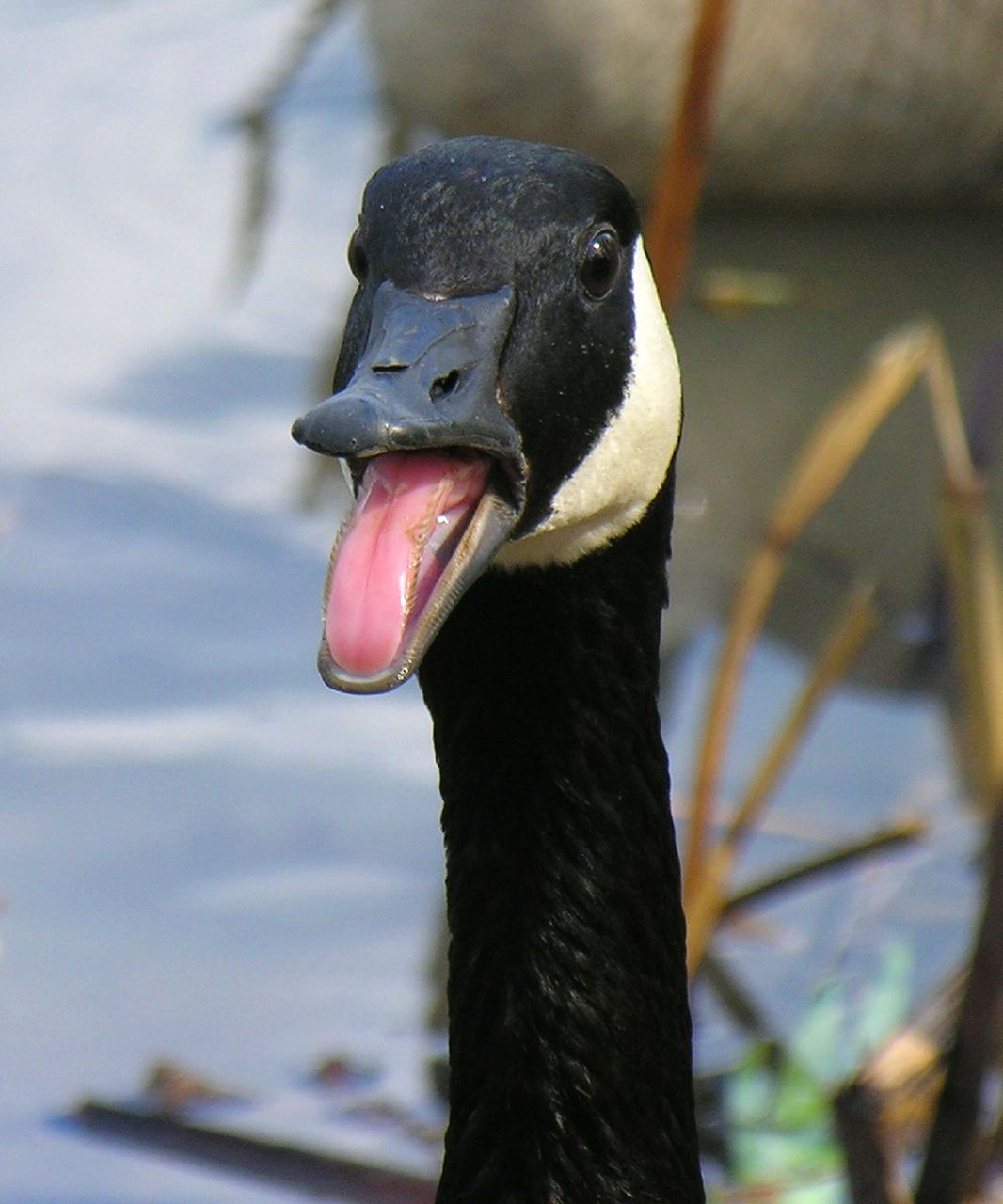
All of this to say, we have an evil Canadian goose in our park. It's the talk of our town, at least among the "library moms" whose preschoolers play at the park. Yesterday morning, when my son tired of the playground and toddled over to watch the ducks and seagulls, this black-headed, black-hearted avian fiend made straight for us. It stopped several feet away, stretched up to its full height, and looked at me like this:


Now, to its credit, this goose only showed up this week with an injured wing, so it's clearly feeling abandoned by its flock. I get that, but that doesn't justify his aggression toward me. Plus, our park is REALLY NICE for birds, insofar as people throw them so much food that they don't even bother eating all of it, and he's bigger than all the other birds, save one big white goose (that my friend named Howard).

As soon as I saw the goose glare and come for us, I picked up Ben and moved away (trying to maintain a calm and non-threatening demeanor). My diversionary tactics seemed successful, but the wicked creature outsmarted me by staking out a spot right next to my water bottle. I really needed the water in that bottle, and I refuse to be one of our town's littering troglodytes, so I had to draw the goose away from the bottle, then rush back to snatch it, all while carrying a squirmy 27-pound boy. Public Works watched the drama unfold from the safety of their vehicle.

When I arrived at the library later that morning and asked my compatriots about the homicidal goose, everyone piped in:
"I saw that goose yesterday! He was scary!"
"He's so out of place! My son kept asking why he was there."
"I saw a policeman trying to catch that goose earlier today! But it didn't work. The policeman lost."

I'm sad to report that, as of this morning, the Canadian blight has not only NOT been removed to a sanctuary or bird hospital, he has corrupted Howard. Both Howard and Canada went after us this morning, and after a narrow escape, I watched them chase and hiss at the poor duck couples for no justifiable reason--at least no reason I can conceive of in the human or goose world.

Tuesday, April 6, 2010

Seven Deadly Sins Meet a Disappointing End

Oh, Mr. Nix, how could you? I'm so disappointed. I devoted myself to each new release of your seven-book The Keys to the Kingdom series, only to arrive at this shoddy end? Alas.

Honestly, I didn't expect it to be as good as Nix's Abhorsen trilogy. TKttK started out fairly strong, stayed interesting for a while, and then got increasingly weaker. The formula felt a bit tired out. None of the characters seemed to develop. The fantasy world was muddled and random. The religious imagery was a good idea to start but didn't seem to hold much significance. And yet...I was hoping for a satisfying ending that would clarify some things. I regained interest as the action in Lord Sunday was fast-paced, and then I came to the final chapter. I was very, very disappointed.

**SPOILERS BELOW**


Yeah, so here's basically what happened. The House is being destroyed by Nothing (ever read or seen The Neverending Story? Yeah, not completely original), so Nix gets to the point where he has two choices: he can either magically stop the Nothing and fix the House/save the world, or he can let it destroy and kill everything, and then bring it all back. Both are pretty cheap tricks, in my opinion. In the final chapter, all in a hurry, Arthur gets ultimate power, a few enigmatic characters are "revealed" (to no real satisfaction), everything gets destroyed, the dang Architect complains that she's tired and just up and LEAVES, and Arthur brings it all back, book over. Oh, yeah, except his mom is dead, so he takes about one sentence to let that sink in, and then everyone goes about their business, blah, blah, blah....SO CRAPPY. There's no payoff for any of the detailed religious imagery, and no creative explanation for this spiritual dimension or its impact on the real world. Ugh.

Oh, yeah, and his sweet little yellow elephant who came to life to help Arthur just got KILLED and then left with no followup. I think I'm more ticked about that than anything.

Oh, and I hate the cover art on this last book. It's completely freaking me out, and not in a good way, partly because of his glowing eyes but partly because Arthur has the hairstyles of an old, frumpy woman with too much hairspray. Also, the cage and hedge pictured look cheap. Cheap like the ENDING.

Thursday, April 1, 2010

Conventions Unconventional

My canon contains many books about bright young girls who aspire to an education and career that seem unattainable. There are several other conventions at work in The Evolution of Calpurnia Tate, and each of them comes across as fresh and convincing. Jacqueline Kelly's young adult novel is about Callie, an 11-year-old girl with six brothers, growing up on a Texas farm in 1899. The story begins during a summer heat wave as Callie develops an interest in the natural world. Her observations and inquiries draw the attention of her grandfather, a reclusive codger who intimidates and generally ignores his grandchildren. Callie and Grandfather Tate discover a mutual love of natural science, much to the consternation of Callie's stern mother, who intends for her only daughter to be a proper young lady, debutante, and capable wife and mother.

Callie is disinterested in and lousy at household duties, but she's quite the impressive scientist. Although her parents can afford and hope to send their eldest son to college, Callie is the one child who really yearns to go (a vexing injustice!). Mr. and Mrs. Tate are strict but caring, and they aren't unlikable, but it's maddening that they can't see their daughter's true potential. Callie feels "like a coyote with its foot caught in a trap" and grows increasingly depressed about her fate, but she also develops a beautifully intellectual and tender relationship with her grandfather, who is sympathetic and encouraging yet doesn't try to undermine Callie's parents. There are a handful of scenes in which Callie is so frustrated with her parents' cluelessness that had me in tears. But one of the greatest joys-within-misery of life is finding the one person who understands you amongst a great many who do not, am I right?

Callie's practice of natural observation also hones her understanding of her friends and family members. She gains a special respect for her mother and the family cook, and is more adept at dealing with her little brother Travis's sensitive personality than anyone in the family. Although imperfect, she grows less selfish and more admirable with each page.

The conclusion is open-ended yet optimistic: Whereas part of me wanted a nice, tidy ending for Callie, I appreciated even more the final chapter's vision of hope.

Kelly's descriptive prose is exquisite. (Incidentally, Jacqueline Kelly is also a practicing physician and lawyer--who makes me feel like a fruitless sluggard!) Often I had to put the book down and pause, then reread a paragraph, because the language is breathtaking. She turns naturalist observations into poetry. Below are a few examples.

The opening lines to the novel are haunting: "By 1899, we had learned to tame the darkness but not the Texas heat. We arose in the dark, hours before sunrise, when there was barely a smudge of indigo along the eastern sky and the rest of the horizon was still pure pitch. We lit our kerosene lamps and carried them before us in the dark like our own tiny wavering suns."

Grandfather Tate describes a small bat who flew into his tent: "Although it still seemed only partly sensible to its surroundings, its feet gripped the twine in what I supposed to be a kind of primitive reflex, and it folded itself with particularity and hung there as if in nature, presenting a compact parcel surprisingly tidy and pleasing to the eye."

Callie describes a caterpillar: "Petey curled into a fuzzy comma when I put the leaves in his jar."

A fuzzy comma! I still haven't gotten over it. Doesn't her way with words makes you want to leap for joy?

Finally, can you even get over that cover art? The silhouette of Callie with a butterfly net surrounded by curious creatures and plants is striking. The book was on display at our library, and I stared at it every time I walked by it, and finally decided to check it out just because the cover is incredible. I'm so glad I did.

Friday, March 26, 2010

Pretzels!

In one of many albums at my parents' house, there's a series of photos of me at age 3 wandering around a fair in Germany eating an enormous pretzel. I have always loved big, soft, warm pretzels, and those Germans really know how to make them. Thanks to Alton Brown, and my brother-in-law Will for tipping me off, now I know how to make them too!

I made these yesterday and they are the best I've had since being in Germany. Ickie and I gobbled them up hot out of the oven with yellow mustard, and Ben enjoyed one when he awoke from his nap. Then we had a second helping with our pub-food dinner (perfect on an overcast, chilly evening), consisting of apple-squash-cheddar soup sprinkled with crispy prosciutto, and beer. The beer was a last-minute acquisition: I flipped out around 5pm realizing how necessary it was, and Ickie took Ben out to the store with him to save the day.

Wednesday, March 24, 2010

Book News

In light of my recent obsession with Connie Willis (see previous post), I just have to mention that she is releasing a new two-part series this year. The first novel is already out (I'm waiting on it via inter-library loan), it's titled Blackout, and it takes place in the same Oxford Time Travel Department universe as Doomsday Book and To Say Nothing of the Dog. There are some unhappy reviewers on Amazon, but as far as I can tell, they're angry because the end of the first novel is a severe cliffhanger. I'd love to wait until part two, All Clear, is released (this coming fall) and do it all at once, but I'm just too eager to read part one. I YEARN for the agony!

Everything is a Symbol

One of my personal highlights in the last year was discovering the works of Connie Willis. When people ask me about her, I say, "She's unique! Her books are something unlike anything I've ever read before." Okay, that's not the case for To Say Nothing of the Dog, which is a tribute to multiple works, and contains comedy equal to those works. However, Doomsday Book was spectacular; bleak at times, but spectacular all the same. And I just finished Passage. I checked it out initially from our library, didn't get around to it, and then checked it out a second time. The premise didn't pique my interest when I read the blurbs about it. But, WOW. It blew my mind. Twice.

Joanna Lander, a psychologist, and Richard Wright, a neurologist, are doing a scientific study on near-death experiences. That sounds only mildly interesting, right? Yet after reading the first 100 pages, I told Ickie, "I just read 100 pages of mostly technical dialogue between two doctors wandering around a hospital and it's GRIPPING!" Willis writes dialogue well; her books are long and filled with it, and she somehow succeeds in making scenes of dialogue referring to the wreck of the Hindenberg, The Rime of the Ancient Mariner, and temporal-lobe stimulation thrilling. I don't even know how she does it. The historical information is fascinating, the literary references are poetic and meaningful, and Willis's descriptive prose is lovely (on one page she goes from a discussion about neurotransmitters to a haunting description of snow falling under sodium streetlights *sigh*).

Anyway, Richard simulates near-death experiences (NDEs) with chemicals, and Joanna interviews the study subjects about what they've seen. They spend most of the book running around Mercy General, the labyrinthine hospital where they work, avoiding a neo-spiritualist hack trying to sabotage their study. Eventually, Joanna decides to undergo the NDE simulation herself. The hospital is a mirror image of Joanna's mental confusion as she struggles to understand what she has seen in her near-death state and derive some sort of medical knowledge or personal significance. I felt the same psychological turmoil and "tip of the mind" feeling that Joanna often has. There are also several other characters who offer insight: Joanna's former literature teacher, who has Alzeimer's; an overly chatty WWII vet; and a little girl with a failing heart who is obsessed with disasters.

I wish I could say more about the plot, but I don't want to give too much away, and honestly, I could write a whole other book about this book. As I mentioned earlier, something wildly unexpected happens two-thirds through, then the plot drags in bits for the last third, and all of a sudden, POW! The final chapter was simply stunning. I was curious and a little skeptical about how Willis could write a novel about NDEs and manage to say something significant, either scientifically or spiritually, without it coming off completely bogus. As in Doomsday Book, there are several Christian or "spiritual" characters whose beliefs are grating, and for a while I assumed that Willis would concentrate on a satisfyingly scientific solution to her mystery. The scientific solution was there, and it was satisfying and significant. But my mind was indeed blown a second time in the final chapter. Everyone and everything in this book is a metaphor or a message. Even the chapter-opener quotes (usually the last words of famous people) are weighty with meaning. Because some traditional/religious beliefs were represented in an off-putting light, I reacted against them (even though I believe many of them), and as a result, I arrived at the finale with open expectations, and Willis's imagery dazzled me.

Passage is a book about death and fear and hope with gallows humor and terror and the best of humanity and everything, everything, is a symbol for something. I could keep writing and thinking about it for days on end, and I wish I had a friend who just read it so that I could discuss it in more detail!